Key Takeaways
- Spatial computing is rewriting the telehealth playbook: The global telehealth market is projected to grow from $186 billion in 2025 to $219 billion in 2026 at a CAGR of nearly 25%, according to Fortune Business Insights, and Apple’s VisionOS platform is emerging as a transformative channel for immersive clinical consultations, remote patient monitoring, and surgical collaboration. Building for VisionOS now positions your business at the intersection of two of the fastest-growing sectors in healthcare technology.
- HIPAA compliance for spatial computing introduces unique challenges: VisionOS apps collect biometric data through eye tracking, hand tracking, and spatial mapping that traditional telehealth platforms never had to consider. The proposed HIPAA Security Rule update — issued as a Notice of Proposed Rulemaking in December 2024 and expected to be finalized in 2026 — would require mandatory end-to-end encryption, multi-factor authentication, and comprehensive technology asset inventories, all of which must account for the novel data streams that spatial computing generates. Even under the current Security Rule, these safeguards represent best practice for any healthcare app handling ePHI.
- Architecture decisions made at the design stage determine your app’s regulatory fate: From choosing between on-device processing and cloud-based FHIR integration to implementing role-based access controls for volumetric patient data, the technical and compliance decisions you make before writing a single line of SwiftUI code will determine whether your telehealth app survives its first OCR audit — or becomes a cautionary tale.
The Convergence Nobody Predicted — And Everyone Needs to Prepare For
If you’re a business leader exploring healthcare app development in 2026, you’ve probably noticed two tectonic shifts happening simultaneously. The first is the continued explosion of telehealth. The global telehealth market is projected to grow from approximately $186 billion in 2025 to $219 billion in 2026, with the U.S. market alone expected to hit over $81 billion this year, according to Fortune Business Insights.
The second shift is the rapid maturation of spatial computing. Apple’s VisionOS platform, now powering the Vision Pro and its evolving ecosystem, has moved from a novelty device to a legitimate clinical tool. Surgeons at Sharp HealthCare in San Diego have launched IRB-approved clinical studies evaluating the use of Apple Vision Pro in cataract surgery. A New York ophthalmologist has performed hundreds of cataract surgeries using the device since October 2025. Cedars-Sinai researchers are developing AI-powered chatbot therapists designed specifically for the spatial computing environment.
These two trajectories are converging. And at the intersection sits one of the most consequential — and most overlooked — questions in healthcare technology right now: How do you build a telehealth application for VisionOS that actually complies with HIPAA?
This isn’t a theoretical exercise. The COVID-era enforcement discretion from HHS is gone. The Office for Civil Rights has made it abundantly clear that telehealth providers are held to the same Security Rule, Privacy Rule, and Breach Notification Rule standards as every other covered entity. The proposed HIPAA Security Rule update — issued as a Notice of Proposed Rulemaking (NPRM) in December 2024 and targeted for finalization in 2026 — would introduce enhanced requirements for remote access security, mandatory multi-factor authentication, encryption standards, and technology asset inventories. Even before the proposed rule is finalized, OCR is actively enforcing the existing Security Rule, and organizations that adopt these proposed safeguards now will be ahead of the compliance curve. And healthcare data breaches remain the most expensive across any industry, with the average healthcare breach costing $7.42 million in 2025, according to IBM’s Cost of a Data Breach Report.
In this blog, we’ll walk through everything you need to know to build a HIPAA-compliant telehealth app for VisionOS in 2026 — from the foundational compliance framework and the unique data privacy challenges spatial computing introduces, to the technical architecture decisions, development workflow, security implementation strategies, and go-to-market considerations that separate successful healthcare app launches from expensive regulatory nightmares. Whether you’re building a patient-facing virtual consultation platform, a clinical collaboration tool, or an enterprise telehealth system designed for spatial immersion, this guide will give you the strategic and technical foundation to get it right.
Understanding VisionOS as a Healthcare Platform
Before we get into the compliance specifics, it’s worth understanding why VisionOS is uniquely compelling — and uniquely challenging — as a platform for telehealth applications.
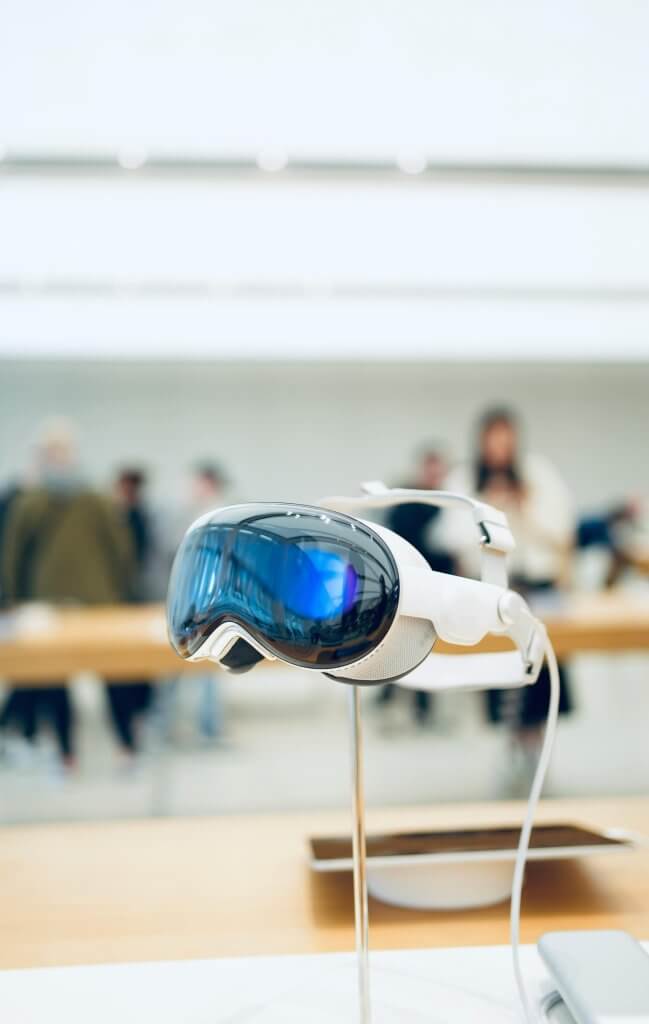
VisionOS is Apple’s operating system for spatial computing, purpose-built for the Vision Pro headset. It combines elements from macOS and iOS with a fundamentally new three-dimensional interface that allows users to interact with digital content using their hands, eyes, and voice. For app development, VisionOS introduces three primary scene types: windows (2D interfaces that float in space), volumes (3D content viewable from any angle), and immersive spaces (fully rendered environments that can range from partial overlays to complete virtual worlds).
For healthcare, this opens up possibilities that traditional 2D telehealth platforms simply cannot match. Imagine a physician conducting a patient consultation where they can simultaneously view the patient’s face in a floating video window, reference a 3D volumetric rendering of the patient’s most recent MRI in an adjacent space, pull up the patient’s FHIR-based health record from the EHR in another window, and annotate findings in real time — all without touching a single peripheral device. Or consider a post-surgical follow-up where the patient uses hand tracking to demonstrate their range of motion while the orthopedic surgeon views the movement data overlaid with pre-operative imaging. These scenarios are not hypothetical. The building blocks exist in VisionOS today.
The core development stack for VisionOS includes SwiftUI for UI and window management, RealityKit for 3D content and AR anchoring, ARKit for world understanding (including plane detection, hand tracking, and scene reconstruction), and Xcode as the integrated development environment. Reality Composer Pro is used to prepare and preview 3D assets. For teams with existing Unity projects, Unity PolySpatial enables content to run on VisionOS while coexisting with other apps in the shared space.
But here’s where it gets complicated for healthcare. VisionOS, by its very nature, collects and processes data that traditional telehealth platforms never had to worry about. The eye tracking system monitors where the user is looking to enable interaction — but that gaze data is biometric data. The hand tracking system captures detailed hand poses and gestures — movement data that could constitute protected health information in a clinical context. The spatial mapping system creates a three-dimensional model of the user’s physical environment — data that reveals intimate details about where the patient lives. And all of this data flows through Apple’s privacy framework, which adds another layer of complexity on top of HIPAA.
Understanding these data streams — and the regulatory implications they carry — is the first step toward building a telehealth app that doesn’t just work on VisionOS but actually survives regulatory scrutiny.
The HIPAA Compliance Framework: What VisionOS Developers Must Know
HIPAA compliance isn’t a checkbox. It’s a comprehensive framework built on three core rules: the Privacy Rule, the Security Rule, and the Breach Notification Rule. Each applies to your VisionOS telehealth app in specific ways that differ from traditional mobile or web-based telehealth platforms.
The Privacy Rule and Spatial Data
The HIPAA Privacy Rule governs how protected health information (PHI) is used and disclosed. PHI includes any individually identifiable health information that is created, received, maintained, or transmitted by a covered entity. In a VisionOS telehealth application, the scope of what constitutes PHI expands significantly beyond what most developers are accustomed to handling.
In a traditional telehealth video call, PHI might include the patient’s name, date of birth, medical history, and the content of the clinical conversation. In a VisionOS telehealth session, PHI could additionally include eye-tracking data that reveals neurological patterns, hand-tracking data that documents motor function assessments, spatial mapping data that reveals the patient’s home environment during a home health evaluation, and volumetric recordings of clinical examinations. Your privacy policies and patient consent workflows need to account for all of these data categories. Patients must be informed about what spatial data your app collects, how it’s used, how long it’s retained, and who has access to it. And because HIPAA defers to more stringent state laws, you’ll also need to consider frameworks like the California Consumer Privacy Rights Act (CPRA), the Washington My Health My Data Act, and similar state-level health data regulations that may impose additional consent requirements for biometric and spatial data.
The Security Rule and Spatial Architecture
The HIPAA Security Rule requires covered entities and their business associates to implement administrative, physical, and technical safeguards to protect electronic PHI (ePHI). In December 2024, OCR issued a Notice of Proposed Rulemaking (NPRM) to strengthen the Security Rule, with the final rule targeted for publication in 2026. While the proposed rule has not yet been finalized — and its timeline carries some uncertainty due to a broader federal regulatory freeze — the direction of travel is clear, and the proposed requirements represent the standard that any new healthcare application should be built to meet. Even under the current Security Rule, encryption and access controls are strongly recommended safeguards that OCR expects organizations to implement unless they can document why an alternative measure is equally effective.
The proposed rule would make end-to-end encryption for all ePHI in transit and at rest a mandatory baseline, eliminating the current distinction between “required” and “addressable” safeguards. For a VisionOS app, this means that every data stream flowing between the headset and your backend infrastructure — video feeds, audio streams, hand-tracking telemetry, eye-gaze data, FHIR API calls, and spatial mapping data — should be encrypted using TLS 1.2 or higher in transit and AES-256 (or equivalent) at rest.

The proposed rule would also require multi-factor authentication for all users accessing ePHI. In a VisionOS context, this introduces interesting design considerations. Apple’s Optic ID (iris-based biometric authentication built into Vision Pro) can serve as one authentication factor, but you’ll still need to implement a second factor — whether that’s a time-based one-time password, a push notification to a paired device, or a PIN.
Additionally, the proposed rule would require a comprehensive technology asset inventory that includes all devices, applications, and systems that create, receive, maintain, or transmit ePHI. Your Vision Pro headsets need to be catalogued, tracked, and subject to the same device management policies as every other endpoint in your healthcare IT environment. This is a detail that many early-stage VisionOS developers overlook entirely.
The Breach Notification Rule and Spatial Incidents
The Breach Notification Rule requires covered entities to notify affected individuals, HHS, and in some cases the media when a breach of unsecured PHI occurs. In the context of VisionOS, a “breach” could look very different from what most organizations are prepared for. If a clinician’s Vision Pro is lost or stolen and contains cached patient data — including spatial session recordings or locally stored FHIR resources — that’s a reportable breach unless the data was encrypted and the encryption key was not compromised. If a vulnerability in your app’s hand-tracking data pipeline exposes motor function assessment data to unauthorized users, that’s a breach. If your spatial mapping data is transmitted to an analytics service without a properly executed Business Associate Agreement, that’s a breach.
Planning for these scenarios during the design phase — not after the fact — is what separates compliant organizations from the ones that end up in OCR enforcement actions.
Business Associate Agreements: The Contract That Makes or Breaks Your App
Before writing a single line of code, you need to have signed Business Associate Agreements (BAAs) with every technology vendor that will create, receive, maintain, or transmit ePHI in connection with your VisionOS telehealth application. This is not optional, and a vendor’s marketing claim that they are “HIPAA compliant” means nothing to OCR without a signed BAA.
For a VisionOS telehealth app, the BAA landscape is more complex than for a traditional mobile health application. You’ll likely need BAAs with your cloud infrastructure provider (AWS, Azure, or Google Cloud all offer HIPAA-eligible services and BAAs), your video communication SDK provider, your EHR integration partner, any analytics or crash-reporting services that might incidentally process ePHI, and any third-party APIs your app calls that handle patient data.
Apple does not sign BAAs for the Vision Pro hardware, iCloud, or the VisionOS operating system as general-purpose platforms. (Apple does offer a narrow BAA for its Health Records “Share with Provider” feature, but that applies specifically to healthcare organizations participating in that program — not to third-party app developers building on VisionOS.) This is an important distinction. Apple’s privacy framework provides strong baseline protections — including on-device processing for biometric data, app-level sandboxing, and the prohibition on apps accessing raw eye-tracking data — but Apple’s terms of service explicitly prohibit using iCloud or other consumer Apple services to store PHI. The compliance burden falls entirely on you as the app developer and on the covered entity deploying your application.
This means that your app architecture needs to be designed so that ePHI is processed and stored within environments covered by BAAs — not on the device itself, unless you’ve implemented encryption and device management controls sufficient to meet the Security Rule requirements for data at rest.
Technical Architecture: Building for Compliance from Day One
The architecture decisions you make at the beginning of your VisionOS telehealth project will determine your compliance posture for the life of the application. Here’s how to approach the key technical decisions.
On-Device vs. Cloud Processing
VisionOS offers significant on-device processing capabilities, powered by Apple’s M-series chips. For a telehealth application, this creates a fundamental architectural choice: how much patient data processing happens on the headset itself versus in the cloud?
On-device processing has clear privacy advantages. Data that never leaves the device doesn’t need to be encrypted in transit, doesn’t flow through third-party infrastructure, and reduces the number of BAAs you need. Apple’s own design philosophy for VisionOS emphasizes on-device processing for sensitive data like eye tracking and hand tracking — the system doesn’t expose raw biometric data to third-party apps.
However, on-device processing has limitations for HIPAA compliance. If you’re caching patient records, clinical images, or session recordings on the Vision Pro for offline access, that data at rest needs to be encrypted, the device needs to be included in your technology asset inventory, and you need remote wipe capabilities in case the device is lost or stolen. For enterprise deployments, this means integrating with a Mobile Device Management (MDM) solution that supports VisionOS.
The pragmatic approach for most telehealth applications is a hybrid model: use on-device processing for real-time interaction (rendering 3D medical imaging, processing hand-tracking input, managing the spatial UI) while routing all persistent ePHI through encrypted API calls to a HIPAA-compliant cloud backend. This minimizes the amount of ePHI that resides on the headset at any given time while taking advantage of the device’s processing power for the spatial computing features that make VisionOS compelling in the first place.
FHIR API Integration
If your VisionOS telehealth app needs to access patient health records from EHR systems — and for most meaningful clinical applications, it will — FHIR API integration is the path forward. FHIR (Fast Healthcare Interoperability Resources) is the global standard for healthcare data exchange, and federal mandates under the 21st Century Cures Act and CMS Interoperability rules have made FHIR compliance non-negotiable for healthcare applications in 2026. The vast majority of U.S. hospitals now use some form of FHIR-enabled system, and the 2025 State of FHIR survey found that 73% of countries with health data regulations now mandate or recommend FHIR.
For VisionOS, FHIR integration presents both an opportunity and a design challenge. The opportunity is that FHIR’s RESTful API architecture — using JSON over HTTPS — is perfectly suited for the Swift networking stack that VisionOS apps are built on. You can use URLSession with TLS 1.2+ to make authenticated FHIR API calls, parse the JSON responses into Swift data models, and render the resulting clinical data in spatial interfaces using SwiftUI and RealityKit.
The design challenge is authorization. The SMART on FHIR framework provides a standardized OAuth 2.0-based authorization mechanism for healthcare apps accessing EHR data. However, the SMART App Launch flow was designed with web browsers and mobile apps in mind — not spatial computing headsets. You’ll need to adapt the OAuth authorization flow for the VisionOS interaction model, potentially using a companion iPhone app for the initial authorization handshake or implementing the authorization flow within a VisionOS window using WKWebView.
Video and Audio Communication
The core of any telehealth application is real-time video and audio communication. For VisionOS, this means implementing a video communication stack that supports the device’s unique capabilities — including its high-resolution passthrough cameras, spatial audio system, and Persona feature (Apple’s digital avatar system for FaceTime calls on Vision Pro).
From a HIPAA perspective, your video communication implementation must support end-to-end encryption for all audio and video streams, session-level access controls (waiting rooms, host approval, PIN-protected sessions), audit logging of all session participants and access events, and recording controls with patient consent management.
Several commercial SDKs offer HIPAA-eligible video communication with BAAs, including Twilio, Vonage, and Daily.co. When evaluating these options for VisionOS, verify that the SDK supports the VisionOS platform (or can be wrapped in a VisionOS-compatible framework), that the vendor’s BAA covers the specific data types your app will transmit (including any spatial data streams you might send alongside the video feed), and that the SDK’s architecture is compatible with your on-device vs. cloud processing decisions.
Spatial Session Recording and Storage
One of the unique capabilities VisionOS offers for telehealth is the potential to create spatial session recordings — three-dimensional recordings of clinical encounters that capture not just video and audio but the spatial arrangement of clinical data, 3D imaging overlays, and hand-tracking-based clinical assessments.
If your application records telehealth sessions in any format, those recordings are ePHI and must be treated accordingly. This means encrypted storage with access controls, retention policies that comply with both HIPAA and applicable state medical records laws (which can require retention periods of 7–10 years or longer for adult patients), secure deletion procedures when retention periods expire, and audit trails documenting every access event.
For volumetric or spatial recordings, storage requirements can be substantial. A standard 2D telehealth video recording might require a few hundred megabytes per session. A spatial recording that includes 3D scene data, hand-tracking telemetry, and volumetric medical imaging overlays could easily require several gigabytes. Plan your storage architecture and cost model accordingly, and ensure that your HIPAA-compliant cloud storage provider can handle the volume.
Development Workflow: From Concept to Compliant Code
Building a HIPAA-compliant VisionOS telehealth app requires a development workflow that integrates compliance considerations at every stage — not as an afterthought bolted on at the end.
Phase 1: Requirements and Risk Analysis
Before you open Xcode, conduct a comprehensive security risk analysis. This is not just a HIPAA best practice — it’s a regulatory requirement. OCR has consistently cited the failure to conduct a thorough risk analysis as the most common HIPAA violation in enforcement actions. Your risk analysis should identify every category of ePHI your app will create, receive, maintain, or transmit, including the spatial data types unique to VisionOS. It should map every data flow — from the patient’s headset through your network infrastructure to your backend storage — and identify vulnerabilities at each point. It should assess the likelihood and impact of each identified threat and document the safeguards you’ll implement to mitigate each risk.
For a VisionOS telehealth app, pay particular attention to risks that are unique to the spatial computing context: unauthorized capture of the patient’s physical environment through spatial mapping, exposure of biometric data through eye or hand tracking, physical security risks associated with shared headsets in clinical settings, and data exfiltration through VisionOS screenshot or screen recording capabilities.
Phase 2: Architecture and Design
With your risk analysis complete, design your application architecture to address each identified risk. Key architectural decisions at this stage include your data classification scheme (what spatial data constitutes ePHI and what doesn’t), your encryption strategy (in transit and at rest, for every data category), your authentication and authorization model, your API architecture for FHIR integration and video communication, your device management strategy for enterprise deployments, and your audit logging architecture.
For the UI/UX design of a VisionOS telehealth app, compliance considerations should inform the spatial interaction design. For example, patient data windows should be designed to minimize incidental exposure — a clinician using the app in a shared clinical space should be able to position patient data windows so they’re not visible to bystanders. Privacy indicators should clearly communicate to both the clinician and the patient when the session is being recorded, when spatial mapping is active, and what data is being transmitted.
Phase 3: Development and Testing
VisionOS development uses Swift and SwiftUI as the primary programming language and UI framework, with RealityKit for 3D content. Building on iOS app development fundamentals, VisionOS extends the Apple development ecosystem into three dimensions. When writing code that handles ePHI, follow secure coding practices that align with OWASP guidelines adapted for mobile and spatial applications.
Key development considerations for HIPAA compliance include implementing certificate pinning for all API connections to prevent man-in-the-middle attacks, using Apple’s CryptoKit framework for any on-device encryption operations, implementing proper session management with automatic timeouts and re-authentication for idle sessions, sanitizing all input data to prevent injection attacks on FHIR API queries, and implementing proper error handling that never exposes ePHI in error messages, crash logs, or debug output.
Testing should include security-focused test cases that verify encryption implementations, access controls, and audit logging. Consider engaging a third-party penetration testing firm with healthcare application experience to conduct a comprehensive security assessment before launch.
Phase 4: Deployment and Ongoing Compliance
Deploying a HIPAA-compliant VisionOS telehealth app involves more than uploading a build to the App Store. You’ll need to ensure that your deployment process includes documentation of all technical safeguards for your HIPAA compliance records, configuration of your backend infrastructure with all required security controls, distribution of BAAs to all applicable business associates, training materials for clinical users on HIPAA-compliant use of the application, and an incident response plan that specifically addresses VisionOS-related breach scenarios.
After launch, ongoing compliance requires regular security risk assessments (at minimum annually, and whenever significant changes occur), continuous monitoring of access logs and security events, patch management for both the application and the underlying infrastructure, periodic penetration testing, workforce training updates, and BAA management as vendors change or contracts expire.
Data Privacy Considerations Unique to Spatial Telehealth
Spatial computing in a healthcare context creates data privacy questions that don’t have established regulatory precedents. As of 2026, no jurisdiction has enacted spatial computing-specific privacy regulation. However, existing frameworks apply in ways that VisionOS telehealth developers need to understand.
Eye Tracking and Gaze Data
Apple’s VisionOS privacy framework is designed so that apps receive the results of gaze interaction (which UI element the user looked at) without accessing raw eye-tracking data. This is a significant privacy protection — your app doesn’t know where the user is looking in physical space, only which virtual element they selected. As of 2026, Apple does not provide raw eye-tracking data to third-party apps through any API, including HealthKit — even for medical or research purposes. Apple has stated this explicitly in developer forums and documentation. This means that if your telehealth app requires clinical-grade eye-tracking data for ocular assessments, neurological evaluations, or attention monitoring, you will need to work with Apple’s enterprise entitlement process or use supplementary external eye-tracking hardware until Apple opens access through a future API. If and when such access becomes available, that gaze data would unambiguously constitute PHI and must be protected accordingly. In the meantime, design your app’s clinical workflows around the interaction data that VisionOS does provide — hover events and selection events — rather than assuming access to continuous gaze streams.
Hand Tracking and Motor Function Data
VisionOS provides apps with hand-tracking data for interaction purposes. In a clinical context, this data can reveal information about a patient’s motor function, tremor patterns, range of motion, and neurological condition. If your app captures or transmits hand-tracking data as part of a clinical assessment — even if it’s primarily collected for UI interaction — that data may constitute PHI. Document your data classification rationale clearly, and when in doubt, treat it as PHI.
Environmental Mapping and Patient Privacy
VisionOS creates a three-dimensional map of the user’s physical environment to anchor virtual content. If a patient uses your telehealth app at home, the spatial mapping data reveals intimate details about their living situation — room dimensions, furniture layout, objects in the room, and potentially other people present. This data could be relevant to a home health assessment, but it could also constitute an invasion of privacy if collected or disclosed without appropriate consent. Design your app to minimize environmental data collection and to clearly inform patients when spatial mapping is active.
Persona and Digital Avatar Data
Apple’s Persona feature creates a photorealistic digital avatar of the user for video communication on Vision Pro. In a telehealth context, the patient’s Persona is being used in a clinical encounter, which means the underlying biometric data used to generate the avatar could potentially be subject to HIPAA protections. Apple processes Persona data on-device and does not provide the underlying biometric data to third-party apps, but your privacy policy should clearly address how Persona-related data is handled during telehealth sessions.
Security Implementation: The Technical Details
With the architectural framework in place, here are the specific security implementations your VisionOS telehealth app needs.
Encryption
Implement TLS 1.3 for all network communications. Use Apple’s Network framework with the appropriate TLS configuration. For data at rest on the device, use Apple’s Data Protection API with the most restrictive protection class appropriate for your use case (NSFileProtectionComplete ensures that data is only accessible when the device is unlocked). For data stored in your cloud backend, implement AES-256 encryption at the storage layer with customer-managed encryption keys.
Authentication and Access Controls
Implement multi-factor authentication using Optic ID (or Face ID on compatible devices) as the biometric factor combined with a knowledge factor (PIN) or possession factor (push notification to a paired device). Implement role-based access controls that distinguish between clinical users, administrative users, and patients, with granular permissions for each data category. Implement automatic session timeouts (HIPAA doesn’t specify a timeout duration, but 15 minutes of inactivity is a widely adopted standard in healthcare).
Audit Logging
Implement comprehensive audit logging that captures every access to ePHI, including the user identity, timestamp, data accessed, and action performed. For VisionOS-specific interactions, consider logging when spatial session recordings are started and stopped, when 3D medical imaging data is loaded and viewed, when hand-tracking data is captured as part of a clinical assessment, and when environmental mapping data is accessed. Store audit logs in a tamper-evident format (such as append-only cloud storage with immutable retention policies) and retain them for a minimum of six years, consistent with HIPAA’s documentation retention requirements under 45 CFR §164.530(j).
Device Management
For enterprise deployments where healthcare organizations are providing Vision Pro headsets to clinicians, implement an MDM solution that supports VisionOS. Key MDM capabilities include remote device wipe in case of loss or theft, enforcement of device passcodes and Optic ID, management of app installation and updates, restriction of non-clinical app usage on managed devices, and configuration of network and VPN settings for secure connectivity to clinical backend systems.
Cost Considerations: What to Budget For
Building a HIPAA-compliant VisionOS telehealth app is a significant investment, and it’s important to go in with realistic expectations about the costs involved.
Development costs for a VisionOS telehealth application will vary based on complexity, but for a feature-complete application that includes real-time video consultation with spatial UI, FHIR-based EHR integration, 3D medical imaging visualization, session recording and playback, comprehensive HIPAA security controls, and enterprise deployment capabilities, you should budget for a development timeline of 9–18 months and a team that includes VisionOS/Swift developers with spatial computing experience, backend engineers with healthcare API expertise, a UX designer with experience in spatial interface design, a security engineer with HIPAA compliance expertise, and a project manager who can coordinate across clinical and technical stakeholders.
Beyond development, budget for a third-party security assessment and penetration test before launch (typically $20,000–$50,000 depending on scope), HIPAA compliance consulting to ensure your policies, procedures, and documentation meet regulatory requirements, HIPAA-compliant cloud hosting (which carries a premium over standard cloud services due to BAA requirements, encryption mandates, and enhanced logging), ongoing security monitoring and incident response capabilities, and annual risk assessments and compliance audits.
The upside of getting this right is substantial. Healthcare data breaches cost an average of $7.42 million per incident in 2025 — and that number only accounts for direct costs. The reputational damage, loss of patient trust, and potential criminal penalties for willful HIPAA violations can be far more devastating. Investing in compliance upfront is dramatically less expensive than remediating a breach after the fact.
Navigating Apple’s App Store Review for Healthcare Apps
Apple has specific guidelines for healthcare apps submitted to the App Store, and VisionOS apps are subject to the same review process. Key considerations include App Store Review Guideline 5.1.3 (Health and Health Research), which requires that apps providing health-related functionality must implement appropriate privacy practices, including obtaining user consent for data collection and clearly communicating how health data will be used. If your app integrates with HealthKit, you’ll need to justify your data access requests and comply with Apple’s HealthKit guidelines.
Apple also requires that apps handling health data use appropriate encryption and security measures. While Apple doesn’t enforce HIPAA directly — that’s OCR’s job — apps that handle health data without adequate security measures may be rejected during review or removed from the App Store after launch.
Additionally, if your VisionOS telehealth app uses the camera or microphone for clinical purposes, clearly communicate this to users and request permissions with context-specific prompts that explain why the access is needed. Vague or generic permission requests are a common reason for App Store rejection.
The Regulatory Landscape Beyond HIPAA
HIPAA is the foundation, but it’s not the entire regulatory picture for a VisionOS telehealth app in 2026.
State-Level Telehealth Regulations
Telehealth enables clinicians to serve patients across state lines, which introduces state-level privacy requirements that layer on top of federal HIPAA. Several states have enacted health privacy laws that are more stringent than HIPAA in specific respects. California’s Confidentiality of Medical Information Act (CMIA) and CPRA impose expanded patient rights and stricter breach notification timelines. Washington’s My Health My Data Act, signed into law in 2023 with key provisions taking effect in 2024, applies to a broader category of health data than HIPAA and imposes consent requirements for data collection and use that go beyond HIPAA’s framework. New York, Texas, and other states have enacted or are considering health-specific privacy legislation with varying requirements.
For a VisionOS telehealth app that serves patients in multiple states, you’ll need a compliance framework that identifies the most stringent applicable requirement for each data handling activity and implements controls that satisfy all applicable jurisdictions simultaneously.
FDA Considerations
If your VisionOS telehealth app includes clinical decision support features, AI-based diagnostic tools, or integration with medical devices or wearables, it may be subject to FDA regulation as a software as a medical device (SaMD). The FDA’s regulatory framework for SaMD is evolving, and the intersection of spatial computing with clinical decision support is largely uncharted regulatory territory. If your app provides clinical recommendations or diagnostic outputs based on patient data — even if those outputs are presented in an innovative spatial interface — consult with a regulatory affairs specialist to determine whether FDA clearance or approval is required.
International Considerations
If you’re planning to deploy your VisionOS telehealth app outside the United States, additional privacy frameworks apply. GDPR treats eye tracking and spatial biometrics as special category data requiring explicit consent. PIPEDA in Canada, LGPD in Brazil, and similar frameworks in other jurisdictions impose their own requirements for health data handling. VisionOS is available in multiple international markets, so if your app will be distributed globally, build a privacy framework that can accommodate multiple regulatory regimes.
Real-World Use Cases: Where VisionOS Telehealth Makes Sense
Not every telehealth interaction needs spatial computing. A routine follow-up appointment for a prescription refill works perfectly well on a standard 2D video platform. The business case for building a VisionOS telehealth app depends on identifying use cases where spatial computing adds clinical value that justifies the additional development investment.
Surgical Consultation and Collaboration
This is the most validated use case. Surgeons are already using Apple Vision Pro in operating rooms for procedures ranging from cataract surgery to colonoscopies. A VisionOS telehealth app designed for surgical consultation could allow a specialist to virtually join a procedure from across the country, viewing the operative field in stereoscopic 3D while discussing technique with the operating surgeon. The ScopeXR platform, which streams live feeds from 3D digital surgical microscopes directly into the Vision Pro, has demonstrated the viability of this approach through hundreds of real-world surgical cases.
Physical Therapy and Rehabilitation
VisionOS’s hand-tracking and body-sensing capabilities make it a natural fit for remote patient monitoring in physical therapy. A VisionOS telehealth app could capture a patient’s range of motion data using the headset’s sensors, overlay that data with baseline measurements, and provide real-time feedback during a therapist-guided session. This creates a more clinically useful telehealth experience than a standard video call, where the therapist is limited to visual observation through a 2D camera. The immersive nature of these experiences draws on the same principles behind augmented reality app development — blending digital content with the physical world to create new forms of interaction.
Mental Health and Behavioral Therapy
Researchers at Cedars-Sinai are already exploring AI-powered virtual therapy on the Vision Pro platform. The immersive capabilities of VisionOS could enable therapeutic environments that reduce patient anxiety — think guided meditation in a calming virtual space, exposure therapy for phobias in a controlled virtual environment, or group therapy sessions where patients interact as avatars in a shared virtual room. For mental health applications, the spatial computing element isn’t just a novelty — it’s a clinical tool that can enhance therapeutic outcomes.
Radiology and Diagnostic Imaging Review
Reviewing 3D medical imaging (CT scans, MRIs, 3D ultrasounds) on a 2D screen has always been a compromise. VisionOS enables radiologists and diagnosticians to view volumetric medical imaging data in true 3D space, rotate it, zoom into areas of interest, and collaborate with referring physicians in a shared spatial environment. A VisionOS telehealth app for radiology consultation could fundamentally change how imaging findings are communicated between specialists and primary care providers.
Common Mistakes to Avoid
Having walked through the comprehensive framework for building a HIPAA-compliant VisionOS telehealth app, here are the most common mistakes we see businesses make — and how to avoid them.
Assuming Apple handles HIPAA compliance for you. Apple provides strong baseline privacy protections through VisionOS, but Apple does not sign BAAs for its consumer hardware or operating systems. HIPAA compliance is your responsibility.
Treating spatial data as non-PHI. Eye-tracking data, hand-tracking data, and spatial mapping data collected during clinical encounters may constitute PHI. When in doubt, protect it as PHI.
Skipping the risk analysis. A comprehensive security risk analysis is not optional. It’s the most commonly cited deficiency in OCR enforcement actions, and it’s the foundation of every other compliance activity.
Using consumer-grade video SDKs. Consumer video platforms like standard Zoom, FaceTime, Google Meet, and Skype are not HIPAA compliant. Use healthcare-grade video SDKs from vendors that provide signed BAAs.
Neglecting device management. Vision Pro headsets that access ePHI need to be managed, inventoried, and subject to the same security controls as any other endpoint device. MDM is not optional for enterprise healthcare deployments.
Overlooking state-level requirements. HIPAA is the federal floor, not the ceiling. State-level health privacy laws can impose additional requirements that your app must satisfy.
Building compliance as an afterthought. Retrofitting security and compliance into an application that was designed without them is always more expensive and less effective than building compliance in from day one. Compliance architecture should be part of your initial app development planning, not a post-launch scramble.
Looking Ahead: The Future of Spatial Telehealth
Spatial computing in 2026 is where mobile computing was in 2010. The hardware is good enough for early adopters, the development platforms are maturing, and the first wave of clinical applications is proving out the value proposition. But mainstream adoption is still on the horizon.
For businesses investing in VisionOS telehealth development now, the strategic advantage is significant. Early movers are building institutional knowledge, establishing clinical workflows, and creating compliance frameworks that will be difficult for late adopters to replicate. The VisionOS ecosystem will only grow — Apple has signaled continued investment through its WWDC announcements and the growing number of healthcare-focused Vision Pro deployments — and the organizations that have already built compliant, clinically validated spatial telehealth applications will be positioned to capture the market as adoption accelerates.
The intersection of spatial computing and telehealth is not a question of if — it’s a question of when and how. And the “how” starts with building compliance into the foundation.
Frequently Asked Questions
Does Apple Vision Pro come HIPAA-compliant out of the box?
No. Apple provides strong privacy protections through VisionOS, including on-device processing of biometric data and app-level sandboxing, but Apple does not sign Business Associate Agreements for its consumer hardware, iCloud, or operating system. (Apple does offer a narrow BAA for its Health Records “Share with Provider” feature, but that applies to participating healthcare organizations, not to third-party app developers.) HIPAA compliance is the responsibility of the app developer and the covered entity deploying the application. You’ll need to implement encryption, access controls, audit logging, and other required safeguards within your application architecture, and you’ll need BAAs with all third-party vendors that handle ePHI.
What types of data collected by VisionOS could be considered PHI?
In a clinical context, several categories of VisionOS data could constitute PHI. Eye-tracking data may reveal neurological patterns relevant to a clinical assessment. Hand-tracking data can document motor function, tremor patterns, and range of motion. Spatial mapping data reveals details about a patient’s living environment that could be relevant to home health evaluations. Session recordings — including volumetric recordings — capture clinical encounters. And any patient health records accessed or displayed within the VisionOS environment are PHI. When in doubt, classify spatial data as PHI and protect it accordingly.
Can I use standard FaceTime or Zoom for VisionOS telehealth?
Standard consumer FaceTime and the consumer version of Zoom are not HIPAA compliant and should not be used for telehealth sessions that involve PHI. However, Zoom for Healthcare is a HIPAA-eligible product that provides a signed BAA. If you’re building a custom telehealth app for VisionOS, you’ll need to use a healthcare-grade video communication SDK from a vendor that provides a BAA — not a consumer video platform.
How much does it cost to build a HIPAA-compliant VisionOS telehealth app?
Costs vary significantly based on scope and complexity, but a feature-complete VisionOS telehealth application with real-time video consultation, FHIR-based EHR integration, 3D medical imaging visualization, comprehensive HIPAA security controls, and enterprise deployment capabilities typically requires a development timeline of 9–18 months. Budget also needs to account for third-party security assessments, compliance consulting, HIPAA-compliant cloud hosting, and ongoing monitoring. The investment is significant, but it pales in comparison to the average $7.42 million cost of a healthcare data breach.
What’s the difference between HIPAA compliance for a VisionOS app vs. a traditional mobile telehealth app?
The core HIPAA requirements are the same — encryption, access controls, audit logging, risk analysis, BAAs, and breach notification. However, VisionOS introduces data categories that traditional mobile telehealth apps don’t handle: eye-tracking data, hand-tracking data, spatial mapping data, and volumetric session recordings. These additional data streams expand the scope of what may constitute PHI, increase the complexity of your encryption and access control implementations, create new device management requirements for headset hardware, and introduce spatial-specific privacy considerations (like environmental scanning) that require novel consent workflows and privacy policies.
Do I need FDA approval for a VisionOS telehealth app?
It depends on the app’s functionality. If your app is purely a communication platform for physician-patient telehealth sessions, it generally would not require FDA clearance. However, if your app includes clinical decision support features, AI-based diagnostic tools, or integration with regulated medical devices, it may be classified as Software as a Medical Device (SaMD) and subject to FDA regulation. The intersection of spatial computing with clinical decision support is largely uncharted regulatory territory, so consult with a regulatory affairs specialist if your app provides clinical recommendations or diagnostic outputs.